

British Boxing Adds Light Cruiserweight Division at 187 Pounds in 2027

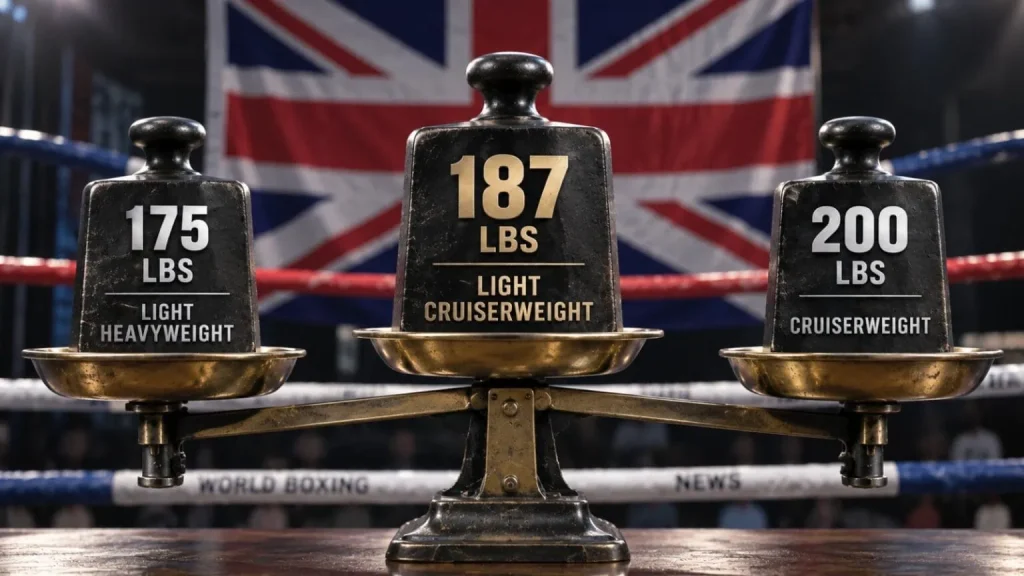
The British Boxing Board of Control will add a light cruiserweight championship class on Jan. 1, 2027, with a limit of 187 pounds. The new division sits between light heavyweight at 175 pounds and cruiserweight at 200 pounds, closing the largest gap on the British scale.
The Board posted the change on Sept. 15. Light cruiserweight will carry a championship ceiling of 13 stone 5 pounds and will be available for Area, English, Celtic, and British titles.
That 25-pound jump from 175 to 200 has been the widest space between two professional championship weights in the sport. Fighters who outgrew 175 either bulked toward 200 or stayed small against bigger men.
The Board’s notice frames the new class as a bridge, not a world-title invention. It does not create a WBC, WBA, IBF, or WBO belt. It creates domestic championships under the British system.
Light heavyweight on the British list is currently held by Lewis Edmondson. Cruiserweight is vacant, with John Hedges and Patrick Brown due to meet on Sept. 19 in Manchester for the British and Commonwealth titles.
Those two divisions stay in place. Light cruiserweight does not replace either one. It adds a third championship door for boxers who naturally live in the high 180s.
British boxing has used this kind of local solution before. Cruiserweight itself was built to stop smaller big men from walking into unlimited heavyweight, and the Board has long sanctioned more title levels than the four world bodies.
This one is narrower. A 12-pound step up from light heavyweight and a 13-pound step down from cruiserweight is closer to the gaps that already exist from middleweight through super middleweight.
The practical effect starts next year. From Jan. 1, promoters can make Area and national title fights at 187 pounds without asking boxers to cut to 175 or inflate toward 200.
No inaugural champion has been named. The Board did not publish a rankings list, a mandatory order, or a first-fight date in the announcement.
That will matter for the men who currently sit between the two established classes. A light heavyweight who struggles to make 175 and a cruiserweight who looks thin at 200 now have a championship weight that does not force either choice.
It will also matter for matchmaking. British cards already run deep at 175 and 200. A new belt gives those shows another title fight that does not require a catchweight clause.
The change is limited to the Board’s jurisdiction. A British light cruiserweight title will not automatically travel to world rankings, and a boxer who wins it still has to decide whether 187 is a destination or a stop on the way to 200.
Cruiserweight remains the world class at 200 pounds, with names such as Jai Opetaia and David Benavidez operating at that limit. Light cruiserweight is a British answer to a British problem.
The Board has overseen professional boxing in Britain since 1929. Adding a weight class is rare enough that the notice stood on its own homepage rather than being folded into a routine championship circular.
What happens after Jan. 1 depends on who actually makes 187. The first Area and English title fights will show whether the division has a real roster or only a number on a scale.
Until then, the British championship map has a new line between Edmondson’s light heavyweight title and the vacant cruiserweight belt. The first man to hold the light cruiserweight championship will be decided in 2027.